
Jim’s Tech Talk
By Jim Langley
Last week we covered Pirelli’s new Smartube road bike inner tube, which is their new high performance TPU tube (TPU stands for thermoplastic polyurethane). In describing their new TPU tube we provided some of the pros and cons of this relatively new type of tube.
Tubes being such important components, we expected to receive great comments and you sure delivered! Thanks very much readers for the feedback with your thoughts on and experiences with TPU tubes and for recommending other types of tubes too. If you missed the article and comments, it’s here: Pirelli Smartube RS TPU Tubes. A shout out to Brian Nystrom for providing a link to the Bicycle Rolling Resistance website which provides comparisons of the various tube types and how they perform.
Leaks at the Valve
Several riders mentioned that TPU tubes can leak at the base of the valve stem. That reminded me of a simple trick for reinforcing the base of the valve to eliminate punctures that cause leaks – regardless of what type of tube it is, which I explain below.
First, I understand that it’s possible for a tube to have or to develop a leak due to a defect in manufacturing. This can happen anywhere there’s a seam on a tube or at the base of the valve where it’s connected and it can also happen with the valve core (the part you loosen and tighten to add and release air).
Today’s hack can’t fix defects. It’s to prevent punctures that are usually caused by something sharp inside the rim cutting into the base of the valve. For example, the edges of the valve hole in the rim can be sharp and if they come in contact with the tube they can puncture it.
This can be exacerbated if the tube is mistakenly installed with the valve stem trapped beneath a tire bead(s). To avoid this, when installing tires, always ensure that the valve is pushed up inside the tire instead of pulling the valve down into the rim. It’s easiest to do this if you finish putting on that least tight section of tire right at the valve. Because you can check one final time that both tire beads are underneath the valve base, not on top of it.
The Hack
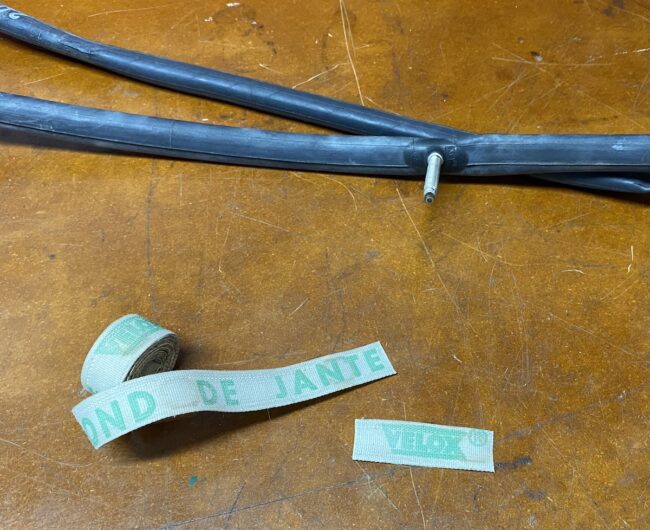
All that’s needed is some material or fabric that’s tough enough to be resistant to cutting. What I use is pieces cut from a cloth rim strip (photos). Whatever you use has to be wide enough to cover the base of the valve. It doesn’t need to be a thick material, just something that won’t get punctured if it comes in contact with anything sharp inside the rim.
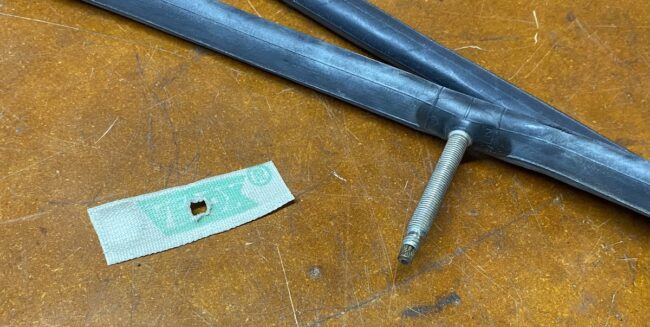
Simply cut a piece long enough to cover the base of the valve and put a hole in it sized to fit snugly over the valve. Slip this reinforcement over the valve as shown, install the tube and tire and you can say goodbye once and for all to punctures at the valve stem!

Jim Langley is RBR’s Technical Editor. A pro mechanic & cycling writer for more than 40 years, he’s the author of Your Home Bicycle Workshop in the RBR eBookstore. Tune in to Jim’s popular YouTube channel for wheel building & bike repair how-to’s. Jim’s also known for his cycling streak that ended in February 2022 with a total of 10,269 consecutive daily rides (28 years, 1 month and 11 days of never missing a ride). Click to read Jim’s full bio.
I had this problem on a mtb, don’t know if it applies here… repetitive punctures at the base of the valve, tried every trick in the internet…the culprit was that the tyre was slipping on the rim when braking and pulling the inner tube with it and the valve against the rim hole…had to go tubeless to solve it… maybe different/more tight tyre would do
I had 2 Vittoria latex tubes leaking from underneath the valve reinforcement, basically after more or less the same amount of of riding hours. Seller gave credit
Query : do this on all tubes, or only after a tube has abraded at rim valve hole? Why not use a small file, such as a chain saw file to deburr the hole? Thank you.
I also use a piece of old tube in place of the piece of rim strip which Jim showed.
Also, I have found that many people with Presta valves do not understand the use of the valve stem nut. They often tighten it down so much that it can pull the valve stem out of the tube. It only needs to contact the rim without any pressure as it only serves to prevent the valve stem from being pushed into the tube when inserting the chuck to air up the tire.
Great tip! Been riding for decades and never seen this one before. I have seem old-school MTBers using a small piece of old inner tube material as a similar ‘grommet’, but rim tape would fit better in narrower road wheels.
I use 2 O rings found at your local hardware store. Go into the plumbing section. Locate the O rings for faucets . I use a small one at the base and a larger on on top. I also use the larger and thicker on on the outside of the rim. 3 in all.
This failure type should not happen. 2 possibilities: the tube is too small for the tire; or the tube manufacturer did not provide sufficient protection for the valve base.
I have had problems on RideNow TPU tubes separating at the valve stem. It isn’t a puncture. Maybe it is manufacturing, I have used a small piece of old inner tube at the valve stem as others have mentioned.
The pink colored RideNow tubes I tried came with a 1″ x 3/4″ piece of self stick material with a small round perforation at its center. The instructions showed it installed over the valve stem. Seems intended to protect the base of the stem from the rim hole, similar to Jim’s hack.
Another option here is to do the following. I have taken old tubes and cut to 1″ sections. Then cut in half. I have a hole punch, which I use to add a hole to each cut section. Slide one over the stem of the tube. Always carry a few with you, just in case. Have used these for years on my tubes. If I could only send you a picture of these, I would.
Happy Trails,
Rick
After a couple of pumps of air, I push the stem up into the tire a bit and then press the bead in under the stem-tube joint. Making sure the tpu tube is fully inside I begin working the bead around in both directions (off the hook!) until I finish on the wheel opposite the stem. Go back and make sure the tube hasn’t been trapped and inflate slowly. Might have to work out anywhere the bead isn’t even. I usually hear a couple of loud snaps as the bead settles in which always brings a smile.
Great idea, not sure if that long of a piece of rim tape is necessary, but whatever as long as it works.
Thankfully I haven’t had that issue but once with a new rim, then I found a bit of a rough area around the stem hole, so I took a very fine file and gently rubbed it off, then went over with fine sandpaper to make it even more smooth, and no more problem.
The problem with tubes made since the last 15 years at least is that the tube manufactures trying to save some money took away the reinforced gromets they use to put inside the tube where the stem came out, they did that to save a penny, and a penny being saved on millions tubes is not chump change, but it also means it forces more people to buy tubes because a leak at the stem can’t be fixed, and thus the tube manufacturers make more money by selling more tubes.